Face casting process
- alinarads
- Nov 4, 2020
- 5 min read
Updated: Jun 15, 2021
The following blog entry will cover the face casting process with the reasons why it is important in the makeup artist industry when creating characters for film and television.
‘Life casting is making a three-dimensional duplicate of a real body part, usually a face or head of a live person. Usually you do this because you need a copy of the performer in order to make custom fitting prosthetic which needs to fit them exactly. It can also be used to make bodies or body parts which are accurate to the performer without sculpting it from scratch.’ (Learn makeup effects, 2014)
By face casting a model, an accurate representation of their facial features is produced, this is important when sculpting and creating prosthetic pieces, ‘it is the process of making and using prosthetic pieces – known as “appliances”. These pieces are stuck to an actor’s skin to create enhanced makeup effects, such as ageing or injuries. Appliances can be made from several suitable materials, including gelatine, silicone and foam latex.’ (Hair and makeup artist handbook, 2020) Using a face cast ensures that the prosthetics fit around the models contours and muscle structure seamlessly. Making the piece look like it belongs to their natural anatomy rather than stuck on and ill-fitting.
In industry it varies on the products and technique used to create face casts, this is due to:
-Budget of the production
-Special effect and prosthetics needed
-Character design
-Availability of actors
-Time frame provided
-Experience and skill of makeup artist/ prosthetic artist
The process of face casting:

To prep the model, all clothing is protected with bin bags and a latex bald cap is applied to cover the hair, the edge of the bald cap is dissolved with acetone and secured around the ears. The model’s eyebrows and eyelashes are painted with Vaseline to prevent any pulling when the face cast is removed.
An aqua paint is applied around the hair line and eyebrows for later referencing where to drill holes for eyebrows and hair line, aswell as the top of the head to mark where the alginate can be placed for the face and back of head if doing a full head cast in industry.
Figure 1

The technique to face casting consists of taking an imprint of the models face with alginate, this first layer picks up the details of the face. Alginate can be purchased from special effects retailers such a Neil’s Materials available from the following link: https://www.neillsmaterials.co.uk/product/lifecasting-alginate/
The alginate is mixed with water in the ratio:
150g : 10ml
(the water is estimated to make a custard consistency)
Figure 2

To prevent the alginate from collapsing mod roc is applied to create structure and a outer 'shell' This is activated with water and smoothed over the set alginate. Mod roc can be purchased from craft stores such as Hobbycraft: https://www.hobbycraft.co.uk/plaster-of-paris-bandage-10cm-x-3m/577665-1000?_br_psugg_q=mod+roc
Figure 3
In reflection to the face casting process, the application went well with an anxious model who suffers with claustrophobia. Although more alginate could have been applied around the nose, the overall process was successful. Due to the model having a small face and head, the bald cap slipped forward with the weight of the alginate causing a ridge in the final cast. In industry the cast would be unusable due the error creating an inaccurate cast this would have to be redone to be as accurate as possible, but it was possible to fix during the sanding process of the plaster face cast.
The alginate and mod rock are removed creating an outer shell, the noseholes are blocked with more alginate to prevent leakage when filling with plaster. The plaster is added to an inch of cold water to create a thick creamy consistency.


Figure 4 & 5
In the figure above you can see the aqua paint line printed into alginate this is why its applied in the prep of the model.
To remove any faults caused by the alginate and smooth the face cast it is: rasped, sand papered to clean up and remove any unnatural lumps and bumps. Holes are drilled in the eyebrow marks and hairline to indicate the space between when sculpting. This stage is extremely important as it creates a smooth base for later when creating a master mould. The figures below show a before and after of cleaning up the cast.

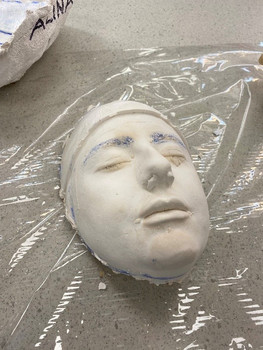


Figure 6 & 7
In reflection of the final plaster face cast, the error from the bald cap was smoothed out successfully as well as the bald cap line round the forehead, the nose area could be neatened up more and smoothed better. Next time the bald cap would be secured better to prevent the crease on the head and the overall cast would be more polished to fit with the industry standards.
Comparison:

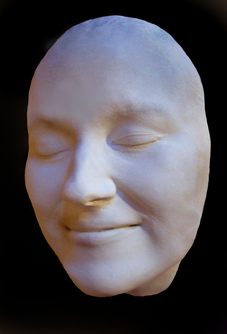

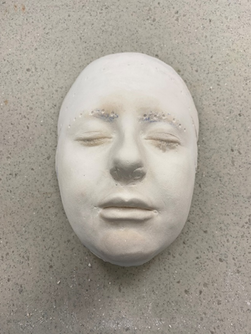
Figure 8 & 9
Compared to a professional face cast, it is evident that the students work need practice to get the edges cleaner and work on their cleaning up process to get it as smooth as possible. With practice and guidance, the student will be able to produce a high quality face cast.



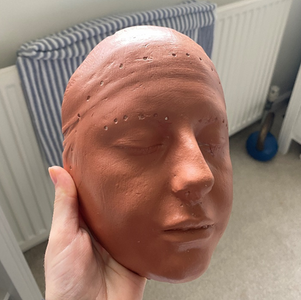
Figure 10 & 11
In comparison to the students first attempt at face casting, figure 11 face cast is better filled with plaster therefore giving more room to sculpt, however figure 10 face cast is smoother on the forehead due to the bald cap fitting better. Over all there is an improvement in the face casting technique between the two images, however further improvement can be made to meet industries high standards producing seamless casts every time.
---------------------------------------------------------------------------------------------------------------------------
Key words:
Alginate – Made from algae extract, becomes rubber, thick liquid when mixed with water. Takes impression of the skin.
Mod roc – Fabric laced with plaster. Usually used for casts on broken bones, wet with water to become malleable and applied to area.
Plaster – Powder mixed with water sets into a hard, heavy material.
References:
Hair and Makeup artist handbook (2020) what is prosthetic makeup [Internet] https://hair-and-makeup-artist.com/prosthetic-makeup/ [Accessed 10/10/20]
Learn makeup effects (2014) Life casting tips and tricks [Internet] http://www.learnmakeupeffects.com/lifecasting-tipstricks/#:~:text=Usually%20you%20do%20this%20because,without%20sculpting%20it%20from%20scratch. [Accessed 03/10/20]
Figures:
Figure 1 - (Radfelder A, 2020) Equipment for face casting prep
Figure 2 - (Radfelder A, 2020) Alginate stage of face casting, York college
Figure 3 - (Radfelder A, 2020) Mod Rock over alginate during face casting process, York college
Figure 4 - (Radfelder A, 2020) Plaster filled cast, York college
Figure 5 - (Radfelder A, 2020) Face cast removed from alginate and mod rock shell, York college
Figure 6 - (Radfelder A, 2020) Plaster face cast before rasping and drilling, York college
Figure 7 - (Radfelder A, 2020) Rasped and sand papered face cast, York college
Figure 8 - (Rockabelly lifecasting, ND) face cast [Image : Internet] https://www.rockabelly.co.uk/facial-portraits-gallery [Accessed 5/10/20]
Figure 9 - (Radfelder A, 2020) Finished face cast cleaned up, York college
Figure 10 - (Radfelder A, 2020) Previous face cast attempt
Figure 11 - (Radfelder A, 2020) Painted face cast


Comments