

Creating an Ancient Roman Wig
- alinarads
- Sep 28, 2020
- 7 min read
Updated: Jan 15, 2021
Research into Roman history:
The Roman Empire was founded when Augustus Ceaser proclaimed himself the first emperor of Rome in 31BC. (Citvitatis Rome (ND) The Ancient Roman ear lasted over 1000 years with fashions changing over the evolutionary time. The class of the individual heavily impacted their appearance, with upper-class women having female slaves style their hair in detailed time-consuming fashions. Hair was highly valued and admired therefore the more complex the hair the more attractive the woman is.
Ancient Roman Hairstyles:
The hair styles of early Romans were heavily inspired by the Greeks with more simplistic hairstyles that consisted of middle partings with loose curls. The images below show examples early Roman hair styles


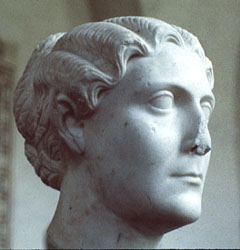

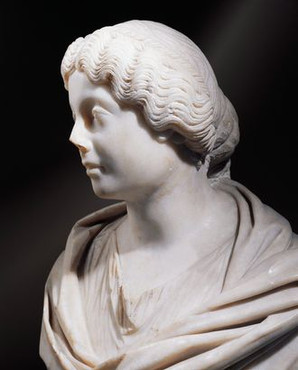
Figure 1, Figure 2 and Figure 3
As the Roman empire took over and evolved, women’s hair became more detailed, extravagant and decorative. ‘Roman women covered the head when necessary with a stola or with a veil. Much attention was given to the arrangement of the hair. For keeping the hair in position pins were used of ivory, silver and gold, often mounted with jewels. Nets and ribbons were also worn. The Roman women of fashion did not scruple to colour her hair, the golden-red colour of the Greek hair being especially admired, or to use false hair which became an article of commercial importance in the Roman empire.’ (Johnston, 1903, p.99) Additional hair was used to create thicker hair, this was usually with the slave’s hair or decapitated soldiers from enemy armies.
This would influence the hair done within the industry by using this research and information the hair stylist might decide to use a stola and additional hair of a different colour to achieve a historically correct look.

Figure 4

Figure 5
As shown in the figures above, a high crown/diadem was created to show the position in the hierarchy. This style came during the Flavian dynasty 69AD –96AD, showing elegance and grace. This detailed, heavy hair was worn by the most powerful women of Rome created to make a crown like effect, a diadem to show off their importance. This hair style could only be achieved with the assistance of slaves and extra hair which were luxuries during them times.



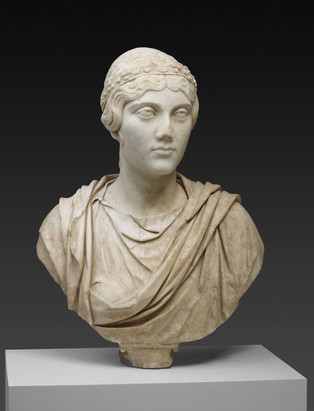
Figure 6, 7 and 8
Ancient Roman Men:
‘Hair was equally as important to men as to women. Most Roman men kept their hair short as a sign of dignity and control. Baldness was ridiculed therefore Julius Ceaser combed his hair forward to hide his receding hairline. Men also curled and dyed their hair to try to preserve the image of youth. For the vast majority of roman history, it was popular for men to be clean shaven as beards were seen as a sign of low status.’ (Lewis (2016) Below are examples of men's hair during the Roman Empire. When styling men’s hair in industry, to achieve the Roman look, either the hair will be cut choppy or curled to create the natural curled effect. The hair will also be dressed with styling products such as oil and wax which can be purchased from the following link: https://www.boots.com/sitesearch?searchTerm=mens%20wax


Figure 9, 10 and 11
Making the wig frame:
To Support the height and weight for the Flavian hairstyle a wig frame needs to be made. An amateur wire frame was made to support the height and weight of the hair, this can be purchased from Industrial Plasters: https://www.industrialplasters.com/prod/armature-wire-wire-netting/armature-wire-1. By making a wig frame this enables the wig master to create height without using all the hair, it creates a surface area that hair can be attached to.
The pictures below show the following steps:
-Using amateur modelling wire - to create the shape and height
-Covering the wire joints with Sellotape - to protect the scalp
-Wrapping lace around the wire frame and sewing to attach - to add body to the structure
-Covering the frame with kanekalon hair - for the hair to pin into
-Sewing a hair net onto the frame – to stop the hair from unravelling


Figure 12, 13, 14 & 15
Setting & Dressing the wig:


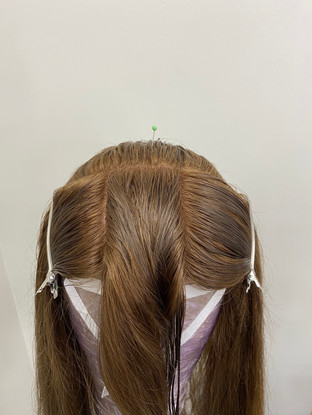


Figure 16, 17 & 18
To start the Flavian wig, a human hair wig is wet sectioned into 4 sections: 3 large sections and the front of the hair and a halo shape around the back of the head. The halo section is put into a ponytail as shown in figure 18.

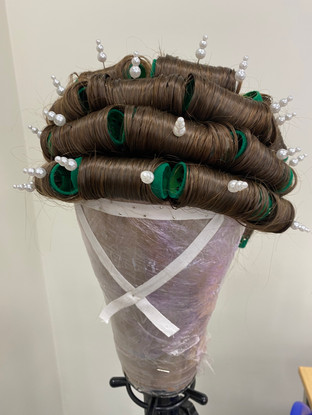

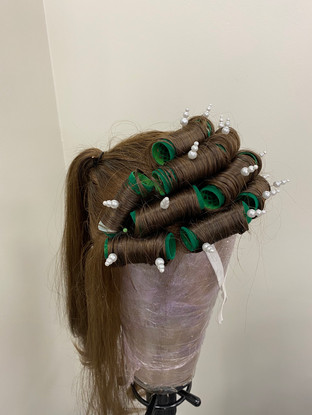


Figure 19, 20 & 21
The front sections of hair are set with flocked rollers into a brick set, these can be purchased from The Wig Department : https://thewigdepartment.com/products/781-24mm-green-flocked-hair-roller-6-5-cm-long?_pos=4&_sid=d7687366b&_ss=r. The rollers are placed to create a new parting in the hair for the wig frame to sit, with the first 3 rows of rollers rolling back towards the back of the head, and the last row rolling forwards. This ensures the diadem is covered later. The ponytail is plaited and the bottom of the hair is placed into vertical rollers.


Figure 22, 23 & 24
Once dry the rollers are removed and the wig frame is placed in the visible section and secured. The wig frame is covered with a small amount of hair to disguise it for when the pincurls are placed on it in the next stage.


Figure 25,26,27 & 28
With the use of oil and wax the curls are individually sectioned and rolled into pin curls, the curls are placed to create rows facing alternative directions at different heights. Each row secured with fine hair pins.


Figure 29, 30 & 31
The section of curls behind the wig frame are also pincurled into one row of larger curls to cover the back of the diadem. The ponytail is placed into a small flat bun so an additional hair piece can be used. The hair clip piece is attached to the hair and plaited to create volume in the bun at the back. The left over strands of hair underneath are wrapped round and pin curled at the back.
Final Images:


Figure 32 & 33
Reflection:
In reflection to the Roman wig set and styling, the set with the rollers was done successfully and neatly as the curls from the wet set rolled up to form effortless pin curls. The front profile is appealing and in proportion although it could be smoother with the use of more product. Next time more time will be taken on the pin curls at the back to make sure they are neat and slightly raised above the front row to add more dimension and interest. The back of the hair didn’t meet the standard of the front due to fatigue and loss of energy during the long 6-hour styling time frame. In review of using the wax and oil, the wax is more successful in smoothing the hair and making it manageable. The oil on the other hand didn’t tame the hair it made the sections of hair slippery and difficult to maintain the pin curl size when rolling. With more practice of this hairstyle the student will be able meet industry standards of immaculate wig styling that is seamless and professional.
Comparison:


Figure 6 & 32
When comparing the students work to an original Roman statue, it is evident that the wig is the same shape and has similar pin curls on the front of the hair. The student's wig would pass in industry with more practise to clean up the fly away hairs and better hidden clips, Next time the student should practice more Roman looks to build their portfolio.
Extra look:


Figure 34, 35 & 36
-----------------------------------------------------------------------------------------------------------------------------------------
Dictionary:
Stola – Traditional roman garment worn by women
Diadem – A type of crown worn by royalty
Kanekalon hair – Synthetic fibre that feels like human hair
Flocked rollers – Rollers with a fibre coat
Reference list:
Civitatisrome (no date) Roman empire (27BC – 476 AD) [Internet] https://www.rome.net/roman-empire [Accessed 02/10/20]
Johnston H, (1903) The private life of the Romans (no publication)
Lewis S, (2016) Roman haircare [Internet] https://coriniummuseum.org/2016/07/roman-haircare/ [accessed 02/10/20]
Figures:

Figure 1
Irving, A (2012) Ancient Roman Hair [Image: Internet] available from: https://retromorphosisit.wordpress.co.uk/2012/09/13/ancient-roman-hair/ [Accessed: 09/10/20]

Figure 2
Thayar B (ND) Coma – Greek word for hair [Image : Internet] http://penelope.uchicago.edu/Thayer/E/Roman/Texts/secondary/SMIGRA*/Coma.html [Accessed 09/10/20]

Figure 3
(The Cut, 2015) Ancient Roman hair [Image : internet] https://www.thecut.com/2015/12/ancient-roman-hair-janet-stephens.html [Accessed 09/10/20]
Figure 4
(Eastland A, 2017) Fonseca Bust, Capitoline Museums, Rome, Italy [Image : Internet] https://www.alamy.com/stock-photo-rome-italy-marble-portrait-bust-of-a-young-flavian-woman-aka-the-fonseca-136724270.html [Accessed 29/9/20]
Figure 5
(Hirapara J, 2020) Roman Hairstyles [Image : Internet] https://www.hairstylevilla.com/roman-hairstyles/ [Accessed 2/10/20]

Figure 6
(Getty, 2015) Hairstyle in Ancient Rome [Image : Internet] https://blogs.getty.edu/iris/no-pain-no-rogaine-hair-loss-and-hairstyle-in-ancient-rome/ [Accessed 2/10/20]

Figure 7
(Sotheby’s, ND) Roman Marble portrait of Livia as Priestess [Image : internet] https://www.sothebys.com/en/buy/auction/2019/ancient-sculpture-and-works-of-art/a-roman-marble-portrait-statue-of-livia-as-a [Accessed 2/10/20]

Figure 8
(Artic, ND) Portrait Bust of woman [Image : Internet] https://www.artic.edu/artworks/159136/portrait-bust-of-a-woman [Accessed 2/10/20]


Figure 9
(J.Paul Getty Museum, ND) [Image : Internet] http://www.getty.edu/art/collection/objects/8212/unknown-maker-portrait-head-of-augustus-roman-25-1-bc/ [Accessed 2/10/20]
Figure 10
(Sosnovskiy S, 2008) Statue of August from Prima Porta [Image : Internet] https://www.flickr.com/photos/sssn09/50047565241 [Accessed 9/10/20]

Figure 11
(TotallyHistory, 2012) Hadrain [Image : Internet] http://totallyhistory.com/hadrian/ [Accessed 9/10/20]

Figure 12
(Radfelder A, 2020) Ametour wire frame, York college

Figure 13
(Radfelder A,2020) Ametour wire covered with lace, Yorkcollege

Figure 14
(Radfelder A, 2020) Kanekalon hair wrapped round the frame, York college

Figure 15
(Radfelder A, 2020) Hair net sewn round wig frame diadem, York College

Figure 16
(Radfelder A, 2020) Starting blocked wig, York college

Figure 17
(Radfelder A, 2020) Sectioning ready for rollers, York College

Figure 18
(Radfelder A, 2020) Halo hair section and ponytail, York college

Figure 19
(Radfelder A, 2020) Front view of roller set, York College

Figure 20
(Radfelder A, 2020) Front flocked rollers applied York College

Figure 21
(Radfelder A, 2020) Ponytail plaited and rollers applied around bottom, York College

Figure 22
(Radfelder A, 2020) Rollers removed, York College

Figure 23
(Radfelder A, 2020) Diadem wig frame placed on section, York College

Figure 24
(Radfelder A, 2020) Diadem covered with hair, York college

Figure 25
(Radfelder A, 2020) First row of pincurls using wax & oil, York College

Figure 26
(Radfelder A, 2020) Second row of pincurls facing the opposite direction, York College

Figure 27
(Radfelder A, 2020) Third row of pin curls formed with wax, York college

Figure 28
Radfelder A, 2020) Final front row of pin curls, York College

Figure 29
(Radfelder A, 2020) Back of the diadem pin curled and smaller sections pinculred, York College

Figure 30
(Radfelder A, 2020) back view of pin curls, Yoek college

Figure 31
(Radfelder A, 2020) Ponytail plaited and additional hair added to the bun, York college

Figure 32
(Radfelder A, 2020) Final Front image of Roman Flavian hair, York college

Figure 33
(Radfelder A, 2020) Final back image of Roman Flavian hair, York College


Figure 34
(Radfelder A, 2021) Exra look for an extra character

Figure 35
(Radfelder A, 2021) Extra look with stola
Figure 36
(Radfelder A, 2021) Extra look


Comments