

Creating a Georgian wig
- alinarads
- Dec 31, 2020
- 12 min read
Updated: Jan 15, 2021
Research into Georgian history:
The Georgian era lasted from 1714 – 1837. Although beautiful from the outside the Georgian and Rococo era ‘The Rococo movement was an artistic period that emerged in France and spread throughout the world in the late 17th and early 18th century.‘ (Ati, 2011) Was far from beautiful with baths once a month and poor hygiene. A lot of Georgian people were infected with diseases such as Syphilis which affected their hair and skin. The Georgian period was over the top with large hair and dresses with men and women both involved in the large outrageous look.
Portraits from the time period cover the imperfections and made the person look flawless. This needs to be considered when relating to the hair and makeup industry as research into the hygiene and living conditions needs to be taken into consideration.

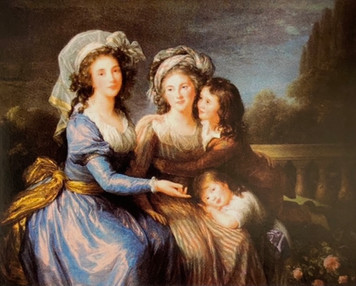





Figure 1, 2, 3 & 4
Georgian Fashion:
Due to the extremely large and accentuating dresses, the wigs were worn to balance out the proportions. The dresses mainly consisting of a corset type bodice to give the illusion of a smaller waist paired with a large heavy hoop skirt filled with ruffles and texture.


Figure 5, 6 & 7
Influential women of the Georgian period:

Marie Antoinette
Marie Antoinette was the Queen of France from 1774 - 1793 she set the trends of the time. 'Marie Antoinette and her elaborately dressed coiffures set the fashion that the other members of the court scrambled to keep up with.' (Lowery A, p.g184, 2013) She is the face of Rococo era with the most traditional look that is associated with that time period.
Figure 8
Georgian Men:
'Also like the women's wigs of this period, men's wigs grew more elaborate. They were dressed very high. Hats were also a part of fashion ranging from tiny hats perched on tall wigs, to tricorns that men carried under their arm so as not to mess up their wigs.
Men who took these fashions to extremes were referred to as macaronis taken from the Italian word maccheeroe which means fool.' (Lowery A, p.g187, 2013)
Men also admired wigs and had expensive ones made from a mix of human and yak hair. Most men shaved their heads and just wore the wigs every day and powdered them to hide the smell. A macaroni shown in figure 10.

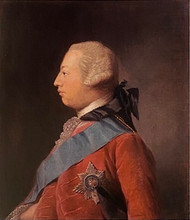


Figure 9, 10, 11 & 12
Georgian Makeup:
Georgian makeup consisted of a light base with heavy rouge in a ‘V’ shape on the cheeks, the rouge was applied with a puff, therefore the result of a larger surface covered and a messier application. To cover signs and scaring of syphilis, men and women covered the patches on the face with small cuttings of rat skin in a circular shape to create ‘beauty marks’. The rest of the face was left natural. The techniques used in the Georgian time period need to be considered when applying makeup for industry, for example a larger brush should be used when applying blush to replicate the placement rather than a small neat brush.

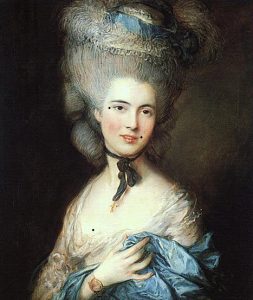

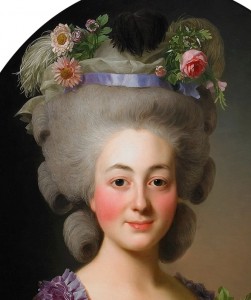

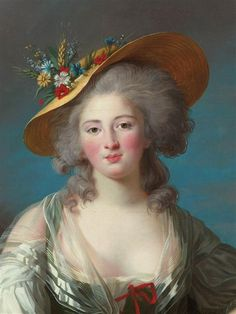
Figure 13, 14 & 15
Georgian Hairstyles:
Georgian hair was enormous and theatrical, using wigs, the hair was built up large to show off the wealth of the person wearing it. ‘This type of hairstyle was achieved by dressing the hair over wire frames and hair pads. Artificial hair was also incorporated into the styles to add volume and height.’ (Lowerly A, pg184, 2013)
The hair was decorated with many accessories such as flowers, beads, hats, feathers and other objects.
Due to high infection of syphilis hair loss and rotting of the scalp was common, to disguise this the wigs were worn and powdered with scented talc to cover the bad smell of rotting flesh.
When recreating a Georgian hair look, its well advised to use a wig that is white or light coloured, styled with techniques similar to first sources for an accurate representation. In industry wig frames will be made and used to create intricate designs and create lighter wigs for actresses to wear.


Figure 16 - 21
Georgian interpretation in film and televison :
The Duchess - Film, 2008
Set in late 18th century
Keria Knightley as Georgiana Cavendish
Hair stylist for Keria Knightley = Loulia Sheppard
Wig maker = Stephanie Hovett


Figure 22 & 23
Bridgerton – Netflix Series 2020
Set in 1813


Figure 24 & 25
Harlots – BBC series 2017
Set in 18th Century London
Hair Stylist/ makeup artist = Sara Austin
Key hair stylist = Sam Smart



Figure 26 & 27

Louis XVI, the Man Who didn’t want to be king, 2011
Figure 28
From the examples above, the hair designers follow the research from the era by using large wigs with added frames and padding to create intricate designs. In comparison ‘The Duchess’ wigs use a more natural colour with less accessories compared to ‘Harlots’ adding a slightly modern - high fashion twist with pops of colour and different textures such as figure 27. The Georgian style is unique as it can be very traditional but can also have a contemporary design, depending on the director and tone of the film/series will determine what route the hair and makeup is following.
Making wig frames:
Wig frames are made to create height and volume within the hair, by using a wig frame less hair is used to build a foundation. Wig frames are also lighter than hair pads/rats or additional hair pieces.
The frames are ideal for Georgian hairstyles as they can be moulded into different shapes and create the extravagant designs.
Steps to making a wig frame:
Armature is used to create shape and height
The joints of the armature wire are sellotaped
Lace is wrapped and sewn round the wire frame
Kanekalon hair is wrapped round
A hair net is sewn over the top


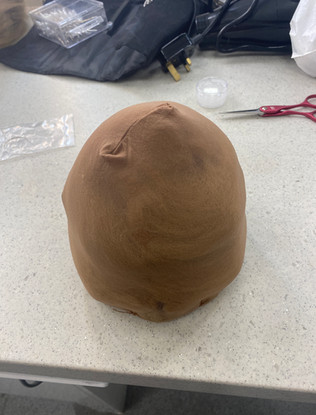
figure 29, 30 & 31

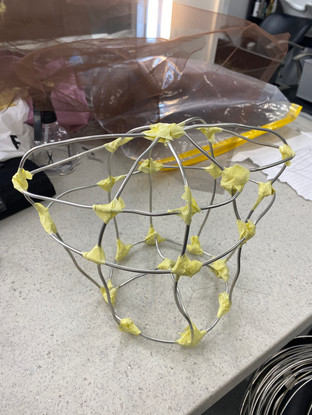


Figure 32, 33, 34
Creating a Male Georgian wig:


Figure 35, 36, 37
To create the traditional mens wig, that would ideally be white. A human hair wig is placed into a low ponytail with the top section left out, which is then set into rik-rak. This technique is done to later create the voluminous height at the front.
The sides of the hair are placed into green flocked rollers for the buckles later.
The remaining ponytail is set with mousse around a dowel rod, the ends of the hair is wrapped in tin foil to keep it tight, the wig is then placed into a wig oven.


Figure 38, 39
The set is removed and dressed out. The rik-rak is brushed out with fingers and gently pinned into a ball shape and secured at the back. the side rollers are removed and rolled back up into buckles and secured with hair grips and hair spray. the ponytail is carefully removed and left as it is.
Talc can be added after as well as the ponytail bobble covered with a ribbon for a more authentic appearance.
Applied wig:


Figure 40 & 41
Reflection:
In reflection to the male wig, the student enjoyed both the set and dress and is also extremely happy with the finished wig as it looks neat and accurate, the buckles are very symmetrical and the rik-rak has enough height. However, during the application of the wig, the buckles became slightly messy and unravelled, also this is a male wig, therefore it looks slightly odd on the student and unsuitable.
Creating female Georgian wig:


Figure 42 & 43
Using a human hair wig, the wig frame from figure 31 is secured on the crown of the head. This is done by placing hair grips in a circle overlapping to create a base, geisha pins are then used to attach the frame to the base of clips. The front section of hair is placed into small flocked rollers in a vertical set for a finger wave later, the sides of the hair are also placed into rollers.


Figure 44 & 45
The back of the hair is placed into flexible curling rods in a vertical set, leaving two small sections of hair out. Using a similar technique to the mens wig, the small sections are wrapped around a curling rod due to not having a dowel rod at home and placed into foil.


Figure 46 & 47
A synthetic additional hair piece is used later for more volume within in the hair, the hair is steamed straight then set into the flexible curling rods and steamed again to set the hair.


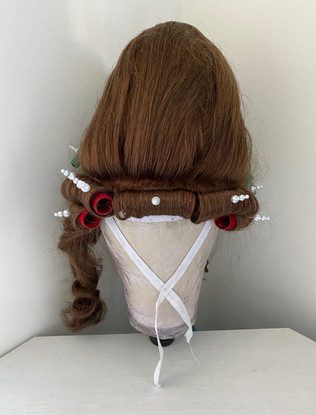
Figure 48, 49, 50
The rollers are removed, and the hair is brushed. Through trial and error, the student first covered the frame with a small amount of hair figure 49, this would enable them to have more hair to form the finger-wave. After attempting to do the finger wave the student decided to only use the last row of rollers to create the design.


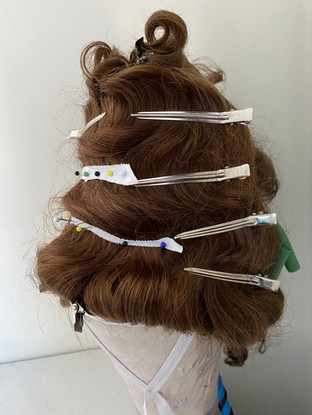


Figure 51, 52 & 53
The last row of rollers were brushed through, following the natural setting pattern a wave was formed, the hair was secured with long sectioning clips and due to running out the student improvised and used scrap material and blocking pins to create their own galloon tape.


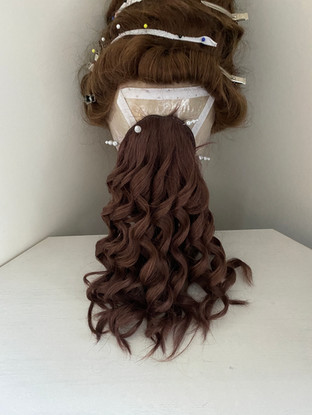


Figure 54, 55 & 56
The curling rods are removed from the back of the hair and is pinned up in layers to create a waterfall of curls. The synthetic additional hair did not set properly therefore the student curled it with low heated curling wand. The extra hair switch was secured in the middle of the head and covered with the wig's original hair figure 56.


Figure 57, 58, 59
The finished Georgian wig without accessories.
Final images:


Figure 60, 61 & 62
Applied wig:



Figure 63, 64 & 65
Reflection:
In Refection to the Georgian wig the student struggled to start the wig set with stress from their personal life getting in the way, after attempting to set the front rollers 3 times and struggling to get the wig frame central the student felt doubtful towards the end result. Re starting the wig at home helped the student although dressing out the hair the student had to do a lot of trial and error without guidance. The dry finger-wave being one of the student's weaknesses as seen on the 1930s wig, was difficult to run smoothly through the hair. The sections of hair seem disconnected in areas, this could be caused by only using one row of the rollers rather than a thicker section.
After accessorising the hair with flowers and beads the student was impressed with their work and proud of the outcome after struggling with the set and dress and doubt during the process. The application of the wig and makeup went well with the end photos being to a high standard. The only critism to give themselves would be to apply more blush and secure the decoration better as majority of the flowers fell out when applying the wig.
Creating female Georgian wig:



Figure 66 & 67
Using a long synthetic wig, the student used the wig frame from figure 34 and the same technique for the human hair wig to attach the frame. Shown in figure 66 is the base of clips for the frame.


Figure 68 & 69
The front of the hair was set in a traditional brick set with large flocked rollers, as the front of the hair was going to be smooth no texture was needed. The sides of the hair were set in large rollers to be later made into buckles.


Figure 70 & 71
The remaining back of the hair is placed into large rik-rak using armature wire as make-shift clips. The student chose to do this technique to contrast the front of the wig as it will be smooth. After the wig is set it is steamed for 30 minutes.


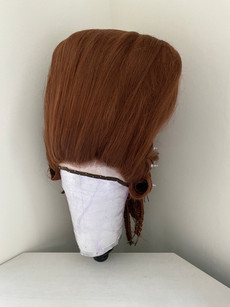
Figure 72, 73, 74 & 75
Once dry the rollers from the front are removed. Learning from the human hair wig, the student decided to do thin layers of hair and smooth the hair before pinning into place.




Figure 76 & 77
The sides of the hair are rolled up into buckles, and secured underneath and between. Hairspray was used to neaten and smooth the front and buckles.


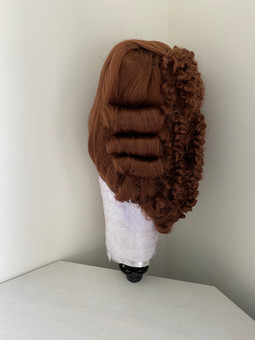
Figure 78 & 79
The back of the hair is removed from the rik-rak set and pinned up to cover the back of the wig frame.
Final images:


Figure 80, 81 & 82
Applied wig:


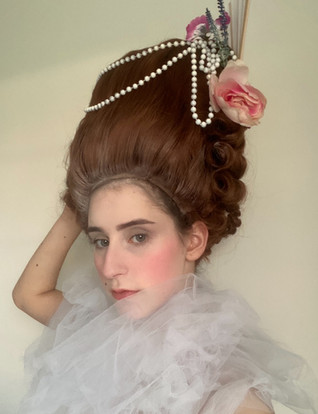
Figure 83, 84 & 85
Reflection:
In Reflection of the synthetic Georgian wig, the student enjoyed the set and dress of this wig as previous experience with the human hair wig prepared them for this one. The set was fast and dressed out exactly as planned. Although it was hard to judge the positioning of the wig cage as the synthetic wig has a long lace front that was ventilated slightly crooked. Therefore, the hair seems slightly off centre.
The application of the wig was difficult as it was extremely heavy, unable to hold it up on its own the student had to support the wig for the images. The wig was too large and slipping around on the students head which is visible in figure 83 and 85, to take the attention away from that area the student applied talc to the wig which unfortunately would not stick to the wig as it is synthetic.
Comparison:


Figure 57 & 22
When comparing the students work to industry standards it is evident that it needs a lot of work to be as polished and camera ready. In figure 22 the finger wave blends into one wave and is smooth all the way to the top where it is twisted inwards, in comparison to the students wig in figure 57 it blends more at the bottom but towards the top it separates and is not fluid. The student could have hidden this by twisting the hair inwards like figure 22. To reach industry standards the student will have to practice the set and make it polished.



Figure 81 & 16
The students work next to the inspiration for the design, it is evident that the student successfully copied the shape, although next time the student should alter their design with more or larger buckles to balance out the large surface area on the front, as they look lost within the design. By doing so the wig will look more like the inspiration picture.
-----------------------------------------------------------------------------------------------------------------------------------------
Dictionary:
Syphilis - A sexually transmitted disease
Coiffures - French word for hairstyle
Rouge - A type of blush
Buckles - Barrel curls on side of wigs
References:
Ati (2011) The rococo art movement that dominated the 17th and 18th century [internet] https://allthatsinteresting.com/rococo-art-movement#:~:text=The%20Rococo%20movement%20was%20an,rock%20and%20shell%20garden%20ornamentation%E2%80%9D. [accessed 12/1/21]
Lowery A (2013) Historical wig styling {Ancient Egypt to the 1830s} Burlington, Focal Press
Figures:

Figure 1
Book : Historical wig styling {ancient Egypt to the 1830s} Allison Lowery (2013) Georgian/rococo women [image] Burlington, Focal Press

Figure 2
(Quara, 2020) [image : internet] https://www.quora.com/What-was-the-difference-between-a-beautiful-woman-in-the-18th-century-and-a-beautiful-woman-today [accessed 5/1/21]

Figure 3
(Historical hussies, 2017) The pursuit of pleasure in Georgian England [image : internet] http://historicalhussies.blogspot.com/2017/02/the-persuit-of-pleasure-in-georgian.html [accessed 5/1/21]

Figure 4
(History of costume, 2012) Rococo era [image : internet] https://historyofeuropeanfashion.wordpress.com/tag/rococo/ [Accessed 12/1/21]

Figure 5
(Blue17, 2014) Georgian fashion – 1714 – 1830 fashion and clothing [image : internet] https://www.blue17.co.uk/vintage-blog/georgian-fashion/ [accessed 5/1/21]

Figure 6
(Pinterest, ND) Georgian fashion 1836 [image : internet] https://www.pinterest.pt/?show_error=true [accessed 5/1/21]

Figure 7
Book : A practical guide to wig making and wig dressing. Melanie Bouvet (2018) Eighteenth century [image] Marlborough, The Crowood press
Figure 8
(Age of revolution, ND) Queen Marie Antoinette of France and two of her children [image : internet] https://ageofrevolution.org/200-object/queen-marie-antoinette-of-france-and-two-of-her-children-walking-in-the-park-of-trianon/ [accessed 11/01/21]

Figure 9
Book : A practical guide to wig making and wig dressing. Melanie Bouvet (2018) Portrait of George 3rd [image] Marlborough, The Crowood press
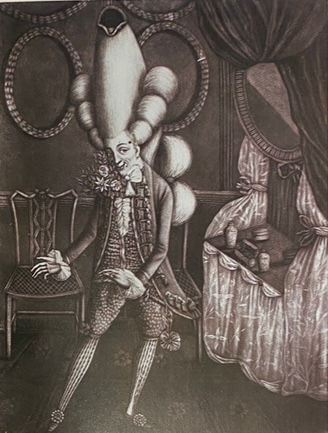
Figure 10
Book : Historical wig styling {ancient Egypt to the 1830s} Allison Lowery (2013) Pantheon Macaroni, 1773 [image] Burlington, Focal Press

Figure 11
Book : Historical wig styling {ancient Egypt to the 1830s} Allison Lowery (2013) Georgian/rococo men [image] Burlington, Focal Press

Figure 12
(Mental Floss, 2012) Why did people wear powdered wigs [image : internet] https://www.mentalfloss.com/article/31056/why-did-people-wear-powdered-wigs [accessed 11/1/21]

Figure 13
(Victorian era, ND) Georgian era makeup [image : internet] http://victorian-era.org/georgian-era-make-up.html [accessed 5/1/21]

Figure 14
(Demonde, ND) Women’s hairstyles & cosmetics of the 18th century [image : internet] http://demodecouture.com/hairstyles-cosmetics-18th-century/ [accessed 5/1/21]

Figure 15
(Morley makeup artistry, 2018) 18th century makeup [image : interent] https://morleymakeupartistry.weebly.com/hairandmakeupthroughouthistory/18th-century-makeup [accessed 11/1/21]

Figure 16
(History revealed, ND) Did rococo wigs have mice? [Image : Internet] https://www.historyrevealed.com/eras/18th-century/did-rococo-wigs-really-have-mice/ [Accessed 19/11/20]

Figure 17
(Vintage news, 2018) Why did so many people wear wigs in the 18th century [Image : Internet]https://www.thevintagenews.com/2018/12/09/wig-18th-century/ [Accessed 19/11/20]

Figure 18
Book : Historical wig styling {ancient Egypt to the 1830s} Allison Lowery (2013) Portrait of Georgiana, duchess of Devonshire [image] Burlington, Focal Press

Figure 19
Book : Historical wig styling {ancient Egypt to the 1830s} Allison Lowery (2013) French hairstyle designed to commemorate victory in American revolution [image] Burlington, Focal Press

Figure 20
Book : Historical wig styling {ancient Egypt to the 1830s} Allison Lowery (2013) The Ladies Waldegrave [image] Burlington, Focal Press

Figure 21
(Grace Elliot, 2013) A short history of wigs [Image : internet] http://graceelliot-author.blogspot.com/2014/12/a-short-history-of-wigs.html [accessed 11/01/21]

Figure 22
(Pinterest, ND) Keira Knightley as Georgiana Cavendish [Image : Internet] https://www.pinterest.co.uk/pin/325314773067694761/ [Accessed 19/11/20]

Figure 23
(IMBD, ND) The Dutchess photo gallery [image : internet] https://www.imdb.com/title/tt0864761/mediaviewer/rm800429056/ [accessed 5/1/21]

Figure 24
(Tatler, 2021) Everthing we know about Bridgerton series 2 [image : internet] https://www.tatler.com/article/bridgerton-season-2-details-plot-release-date-cast [accessed 11/1/21]

Figure 25
(The cut, 2020) All the best hair looks from Netflix’s Bridgerton [Image : internet] https://www.thecut.com/2020/12/all-the-best-hair-looks-from-netflixs-bridgerton.html [accessed 11/1/21]

Figure 26
(The sun, 2020) Harlots season 3 starts on BBC 2 tonight [image : internet] https://www.thesun.co.uk/tv/12316792/harlots-what-time-bbc-two/ [accessed 11/1/21]

Figure 27
(The cut, 2017) Harlots trailer review [Image : internet] https://www.thecut.com/2017/03/watch-the-trailer-for-hulus-new-brothel-drama-harlots.html [accessed 11/01/21]
Figure 28
(Pinterest, ND) https://www.pinterest.co.uk/pin/404057397802102084/ [Accessed 5/1/21]

Figure 29
(Radfelder A, 2020) Armature wire frame, York College

Figure 30
(Radfelder A, 2020) Lace wrapped round wire frame, York college

Figure 31
(Radfelder A, 2020) Finished wig frame, York college

Figure 32
(Radfelder A, 2020) Larger wire frame, York college

Figure 33
(Rdafelder A, 2020) Kanekalon hair wrapped round frame, York college

Figure 34
(Radfelder A, 2021) Finished wig frame

Figure 35
(Radfelder A, 2020) Front view of set male wig, York college

Figure 36
(Radfelder A, 2020) Side view of male set, York College

Figure 37
(Radfelder A, 2020) Ponytail set for mens wig, York College

Figure 38
(Radfelder A, 2020) Front view of finished male wig

Figure 39
(Radfelder A, 2020) Back view of finished male wig

Figure 40
(Radfelder A, 2020) Applied wig with talc

Figure 41
(Radfelder A, 2020) Applied wig with talc

Figure 42
(Radfelder A, 2020) start of wig set

Figure 43
(Radfelder A, 2020) Front view of roller set

Figure 44
(Radfelder A, 2020) Before applying flexible curling rods

Figure 45
(Radfelder A, 2020) Felxile rod set

Figure 46
(Radfelder A, 2020) Aditional hair peice before

Figure 47
(Radfelder A, 2020) Synthetic hair set


Figure 48
(Radfelder A, 2020) removed rollers
Figure 49
(Radfelder A, 2020) first covering of wig frame

Figure 50
(Radfelder A, 2020) Fully covered wig frame

Figure 51
(Radfelder A, 2020)
Side view of fingerwave

Figure 52
(Radfelder A, 2020)
Close view of finger wave

Figure 53
(Radfelder A, 2020)
Fingerwave on wig

Figure 54
(Radfelder A, 2020)
Curling rods removed

Figure 55
(Radfelder A, 2020)
Extra hair synthetic switch curled

Figure 56
(Radfelder A, 2020)
Hidden hair switch

Figure 57
(Radfelder A, 2020)
Finished front view

Figure 58
(Radfelder A, 2020)
Side view of finished wig

Figure 59
(Radfelder A, 2020)
Finished back of hair

Figure 60
(Radfelder A, 2020)
Finished Georgian hair decorated

Figure 61
(Radfelder A, 2020)
Side view of finished Georgian wig

Figure 62
(Radfelder A, 2020)
Back view of Georgian hair

Figure 63
(Radfelder A, 2020)
Applied Georgian wig and makeup

Figure 64
(Radfelder A, 2020)
Side view of applied wig

Figure 65
(Radfelder A, 2020)
Back view of applied georgian wig

Figure 66
(Radfelder A, 2020)
Base for wig frame

Figure 67
(Radfelder A, 2020)
Secured wig frame

Figure 68
(Radfelder A, 2020)
Front roller set

Figure 69
(Radfelder A, 2020)
Side rollers

Figure 70
(Radfelder A, 2020)
Before rik-rak is applied

Figure 71
(Radfelder A, 2020)
Back of hair in rik-rak

Figure 72
(Radfelder A, 2020)
First layer to cover wig frame

Figure 73
(Radfelder A, 2020)
Fist two rows of rollers pinned into place

Figure 74
(Radfelder A, 2020)
Final row of rollers removed

Figure 75
(Radfelder A, 2020) Front of wig smoothed

Figure 76
(Radfelder A, 2020)
Side view of buckles

Figure 77
(Radfelder A, 2020)
Side view of buckles

Figure 78
(Radfelder A, 2020)
Finished back of hair with removed rik-rak

Figure 79
(Radfelder A, 2020)
Side view of finished wig


Comments